Dividends, withholding tax and FIFO: keeping track as an investor in Germany
With a German broker, the flat-rate tax on investments mostly runs on its own. Three mechanisms are still worth understanding, especially if you moved to Germany with an existing portfolio: FIFO on sales, foreign withholding tax on dividends, and the role of exchange rates. With worked examples, and a clear line on where an app helps and where it doesn't.
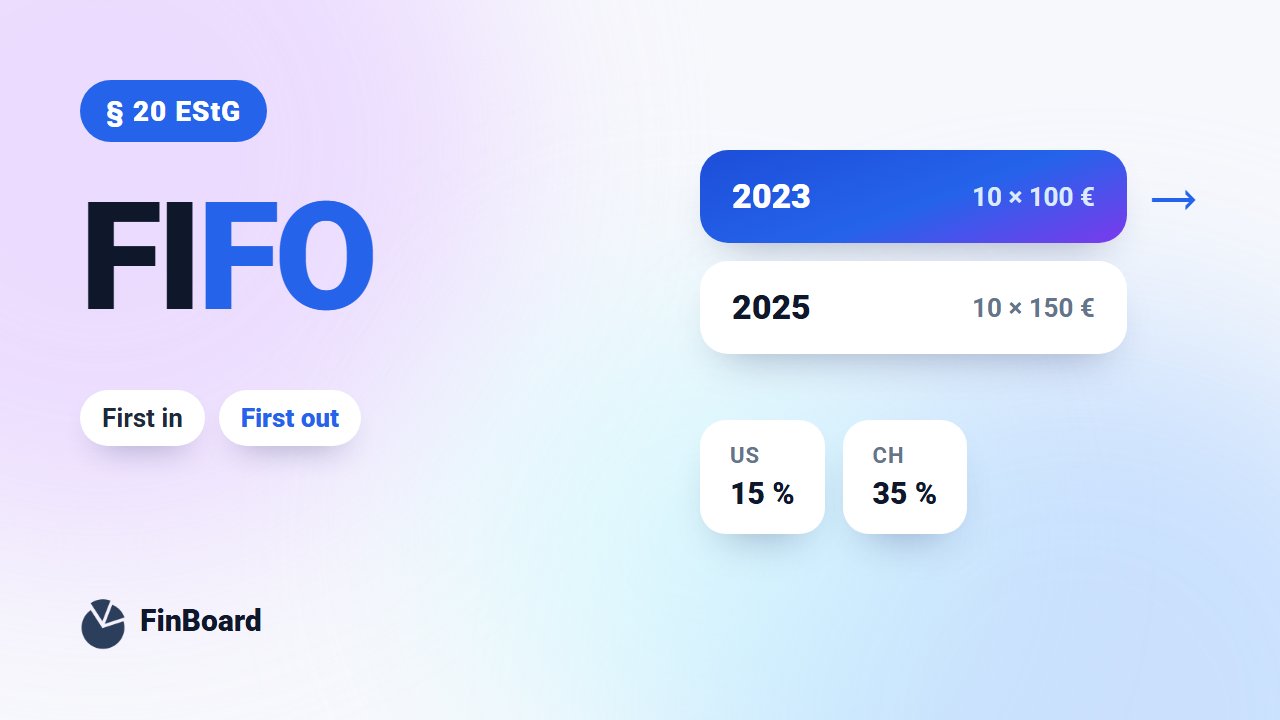
Table of contents
- The basics: 26.375% and €1,000
- FIFO: you don't get to choose which shares you sell
- The exchange rate is part of your gain
- Withholding tax: what stays abroad
- Several depots, or a broker abroad
- Where FinBoard helps, and where it doesn't
- FAQ
- How much foreign withholding tax does Germany credit?
- Does FIFO apply to ETFs?
- Why does my app show a different gain from my bank?
If you invest through a German bank or broker, you barely notice tax: the bank withholds the flat-rate tax (Abgeltungsteuer), applies your exemption order and nets off losses. Still, the statements sometimes show figures you didn't expect, and if you moved here with a portfolio from the UK, the US or elsewhere, the rules may differ from what you're used to. Three mechanisms explain most of the surprises: FIFO, withholding tax and exchange rates.
This article covers all three with worked examples. It is written for private investors who are tax resident in Germany, reflects the rules as of October 2026, and is not tax advice.
The basics: 26.375% and €1,000
- Flat-rate tax (Abgeltungsteuer): 25% on investment income, plus a 5.5% solidarity surcharge on that tax, which makes 26.375%. With church tax it comes to roughly 27.8% to 28%, depending on the state.
- Saver's allowance (Sparerpauschbetrag): €1,000 a year, €2,000 for married couples and registered partners. You split it across your banks with an exemption order (Freistellungsauftrag).
- German bank or broker: withholds the tax, nets off losses and credits foreign withholding tax.
- Foreign broker: withholds no German tax. You declare the income yourself on Anlage KAP of your tax return.
FIFO: you don't get to choose which shares you sell
For securities held in collective custody, which covers practically every share and ETF in a depot, § 20(4) sentence 7 of the Income Tax Act says the shares bought first count as sold first. That is FIFO, first in, first out. If you're used to other rules, such as the UK's share pooling, this is a real difference. An example:
- March 2023: buy 10 shares at €100
- May 2025: buy 10 more at €150
- October 2026: sell 10 shares at €160
Under FIFO you sell the 2023 shares. Your taxable gain is 10 × (€160 − €100) = €600. If your allowance is used up, that means €158.25 in tax and surcharge.
If you calculate with the average cost of €125 instead, you get a gain of only €350. Many apps show exactly that average, which is why the bank's statement comes as a surprise. Over the full holding period it evens out: the remaining 10 shares are booked at €150, so their later gain is smaller. What changes is mainly when you pay the tax.
Purchase and sale fees reduce your gain, by the way. Recording them gets your numbers closer to the bank's.
The exchange rate is part of your gain
For transactions in a foreign currency, the law converts your purchase cost at the rate on the purchase date and your sale proceeds at the rate on the sale date (§ 20(4) sentence 1 EStG). Currency moves therefore end up inside your taxable gain.
An example with a US share:
| Price in dollars | EUR/USD | Value in euros | |
|---|---|---|---|
| Purchase | $100 | 1.10 | €90.91 |
| Sale | $100 | 1.00 | €100.00 |
In dollars you made nothing. For German tax you made €9.09, because the dollar rose against the euro. The reverse also happens: a weaker dollar can wipe out a price gain.
Withholding tax: what stays abroad
Many countries withhold tax on dividends before the money reaches you. Germany credits that against its flat-rate tax, but only up to the rate set in the double taxation agreement with that country, usually 15%.
United States: without a W-8BEN form the US withholds 30%, with it 15%. German banks usually handle the form for you. The 15% is credited in full. On a €100 dividend (kept in euros for simplicity):
- €15.00 withheld in the US
- €25.00 German tax minus €15.00 credit: €10.00 paid in Germany
- €0.55 solidarity surcharge (5.5% of the remaining €10.00)
- Total: €25.55, slightly less than the €26.375 on a German dividend, because the surcharge only applies to the German part
Switzerland: Switzerland withholds 35%. Germany credits 15%. You reclaim the remaining 20% by filing a claim with the Swiss Federal Tax Administration (ESTV). Until you do, your total burden on a €100 dividend is €45.55.
One catch: the credit only works if you owe German tax that year. If your allowance covers all your income, the creditable withholding tax is lost. It cannot be carried forward.
Several depots, or a broker abroad
The more depots you have, the more you have to track yourself:
- Exemption orders: the total across all banks must not exceed €1,000 (or €2,000).
- Losses at bank A, gains at bank B: you can only offset them through your tax return. Request a loss certificate (Verlustbescheinigung) from bank A by 15 December.
- Broker abroad: you work out FIFO, the euro conversion and withholding tax yourself and report them on Anlage KAP.
- Equity ETFs: 30% of the income is tax-exempt (Teilfreistellung). A German bank applies this automatically; with a foreign broker, you apply it yourself.
Where FinBoard helps, and where it doesn't
FinBoard is an overview tool, not tax software. What it does:
- FIFO gain per sale: for the trades you record, using the same logic as your bank.
- Dividends with withholding tax: rate and amount, source country, settlement currency and exchange rate. FinBoard works out the net amount. Check the suggested rates per country against your statement and adjust them if needed.
- Everything in euros: positions in other currencies are converted into your default currency with ECB reference rates.
What it doesn't do: FinBoard produces no tax certificate and no Anlage KAP. It doesn't manage exemption orders or loss pots and doesn't calculate the Vorabpauschale on funds. Your bank's annual tax certificate remains what counts and, with a broker abroad, your own return. FinBoard helps you see during the year which gains and dividends are adding up, and make sense of your bank's statements.
FIFO and dividends are part of the Basic plan. How FinBoard handles your data overall is covered in 7 privacy questions to ask before you connect your bank.
FAQ
How much foreign withholding tax does Germany credit?
At most the rate in the double taxation agreement with that country, usually 15%. Anything withheld above that can only be reclaimed abroad.
Does FIFO apply to ETFs?
Yes. Fund units in collective custody are sold on a FIFO basis too. Equity ETFs also get the 30% partial exemption.
Why does my app show a different gain from my bank?
Usually because the app uses average cost instead of FIFO, leaves out fees, or converts foreign currency at today's rate instead of the rate on the transaction date.