A YNAB alternative for Germany: FinBoard vs YNAB, compared honestly
YNAB is the reference for envelope budgeting, and many people who move to Germany bring it with them. Then the friction starts: whether your Sparkasse or Volksbank connects at all, and the fact that your data lives in the US. A factual comparison with FinBoard, including the points where YNAB is the better choice.
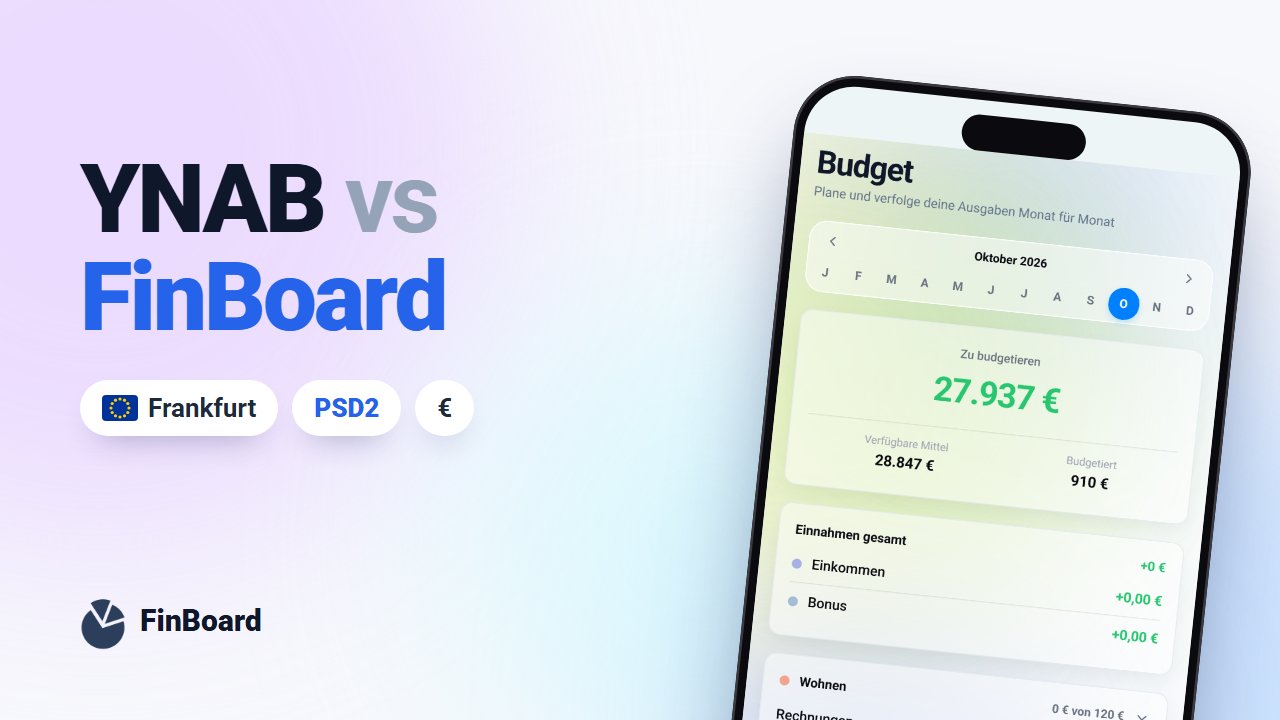
Table of contents
- The short version
- The method: same principle, different focus
- Connecting German banks
- Where your data lives
- Investments, crypto and loans
- Prices compared
- Which one fits you?
- Switching from YNAB to FinBoard
- FAQ
- Does YNAB work with German banks?
- Is FinBoard free?
- Does FinBoard store my online banking login?
YNAB ("You Need A Budget") changed how a lot of people handle money. The idea is simple and it works: give every euro a job before you spend it. Many people who move to Germany bring YNAB with them, and then run into friction. Whether your new German bank connects depends on the bank, and your data is stored in the United States.
This article compares YNAB and FinBoard point by point. FinBoard is our product, so we spell out where YNAB is the better choice too. Everything below is as of October 2026.
The short version
- Method: Both use zero-based envelope budgeting. YNAB's version is more mature, for example its per-category targets.
- Language: YNAB is English only. FinBoard is available in English, German and Spanish, which helps when you share it with a German-speaking partner.
- Banks: FinBoard connects to around 1,100 German institutions through PSD2, from Sparkassen to DKB. YNAB offers Direct Import in Europe for selected banks.
- Data location: YNAB stores and processes data in the US. FinBoard's database is in Frankfurt.
- Net worth: FinBoard tracks your depot, crypto wallets and loans with positions and prices. YNAB keeps investments as a single balance.
- Price: YNAB costs €15.49 a month or €119 a year on the German App Store. FinBoard Basic is €4.99 a month plus VAT.
The method: same principle, different focus
YNAB is built on four rules. The core one: only budget money you already have, and give every euro a job. Whatever is left in a category rolls into next month. When you overspend somewhere, you cover it from another category.
FinBoard's budget works on the same principle. At the top sits the amount still to be budgeted, and below it you assign that money to categories month by month. Leftovers roll over, overspending is covered from another category, and you can move money between categories. If you come from YNAB, you will feel at home quickly.
Where YNAB is ahead: it has spent years building features around the method, such as per-category targets, plus a large library of workshops and guides. FinBoard does not have savings-goal templates yet.
Where FinBoard puts its focus: the budget is one part of a wider picture. Next to it sit your net worth, including your depot, crypto and loans, and a forecast of up to twelve months.
Connecting German banks
Without automatic transactions, every budget turns into data entry. This is where the two differ most.
YNAB has offered Direct Import in Europe through the US provider Plaid since February 2025, for what it calls select banks. Check whether your Sparkasse or Volksbank is on the list before you subscribe. For everything else you are left with file imports or third-party tools.
FinBoard uses GoCardless Bank Account Data, an account information service licensed under PSD2. Its catalogue lists around 1,100 German institutions, including Sparkassen, Volks- and Raiffeisenbanken, comdirect, Commerzbank, Consorsbank, Deutsche Bank, DKB, ING, N26 and Postbank. Three things matter here:
- Read-only access: FinBoard fetches balances, account details and transactions. The connection cannot initiate payments.
- Credentials stay with your bank: you log in on your bank's own page. Neither FinBoard nor GoCardless sees or stores your login details.
- Consent lasts up to 180 days: after that you confirm it again with your bank. FinBoard reminds you seven days before.
We explain what you actually authorise in What exactly are you authorising when you connect your bank to an app? One limitation belongs here too: Trade Republic and Scalable Capital are not in the catalogue at the moment. You bring their transactions in through a CSV import.
Where your data lives
YNAB states in its privacy policy that the service is operated from the United States, and that data from users elsewhere is transferred to, processed and stored in the US. Transfers from the EU rely on the European Commission's Standard Contractual Clauses.
FinBoard is an EU company, based in Spain, and falls directly under the GDPR. The database that holds your accounts, transactions and positions runs in Frankfurt (AWS region eu-central-1). Every row is tied to your user account through row-level security.
For the full picture: when you use AI features, the content they need goes to our AI provider, Anthropic, in the US. The chat sends only your question, never names, amounts or balances. The AI import sends the first rows of your file, and the receipt scanner sends the photo of the receipt. If you don't use these features, nothing is sent for them.
You can also export all your data as CSV at any time and delete your account yourself. Deleting it also revokes the access you granted to your bank.
Investments, crypto and loans
YNAB is a budgeting tool. Investments live in a "tracking account" whose balance you update by hand. It has no concept of individual positions, prices or dividends.
FinBoard is built around your whole net worth:
- Depot: positions with daily prices, profit and loss per sale using FIFO (the method German banks apply for tax), and dividends with withholding tax.
- Crypto: wallets on nine networks, including Bitcoin, Ethereum and Solana, added by public address only, never with a private key.
- Loans: mortgages and personal loans as their own accounts, counted in your net worth.
- Currencies: accounts in 26 currencies, converted with European Central Bank reference rates. Useful if your savings are still partly in pounds or dollars.
Prices compared
| YNAB | FinBoard | |
|---|---|---|
| Free | 34-day trial | Free plan, no time limit, no budgeting |
| Monthly | €15.49 (App Store) | Basic: €4.99 plus VAT |
| Yearly | €119.00 (App Store) | Basic: €49.90 plus VAT |
| More capacity | – | Pro: €14.99 a month plus VAT |
| Sharing | up to 6 people per subscription | one login per person |
With Germany's 19% VAT, FinBoard Basic comes to €5.94 a month or €59.38 a year. App Store prices can differ slightly because of Apple's price tiers. The free plan includes one bank connection with automatic sync. Budgets, forecasts, FIFO, dividends, crypto wallets and multiple currencies start with Basic. On its website, YNAB lists its prices in US dollars: $14.99 a month or $109 a year.
Which one fits you?
YNAB fits if the budgeting method is what you are after, you share your budget with a partner, you rely on per-category targets, and US data storage doesn't bother you.
FinBoard fits if you want your data kept in the EU, need your German bank accounts to sync automatically, and want your budget, depot, crypto and loans in one view, in English or German.
Switching from YNAB to FinBoard
- Export from YNAB: on the web, download your budget as a ZIP file of CSVs. The register file holds account, date, payee, category, outflow and inflow.
- Connect your banks in FinBoard: depending on the bank, earlier months of transactions come along when you connect.
- Import older history: upload the register file through the CSV import on the web. Map the columns yourself or let AI detect them, which is optional. FinBoard flags likely duplicates before importing.
- Set up your budget: recreate your categories and amounts once by hand. It's a good moment to clean out old categories.
FAQ
Does YNAB work with German banks?
Partly. YNAB offers Direct Import in Europe for selected banks. For the rest, you import statements as files.
Is FinBoard free?
There is a free plan with no time limit that includes a bank connection and automatic sync. Envelope budgeting starts with Basic. There is no free trial of Basic or Pro.
Does FinBoard store my online banking login?
No. You log in directly with your bank. FinBoard gets read-only access to the accounts you choose to share.
The free plan has no time limit: finboard.me