
How Your Stock and Crypto Gains Are Taxed in Spain
Selling stocks, funds, or crypto at a profit has tax consequences that many retail investors discover too late. Here's a clear breakdown of how taxation works in Spain in 2026.
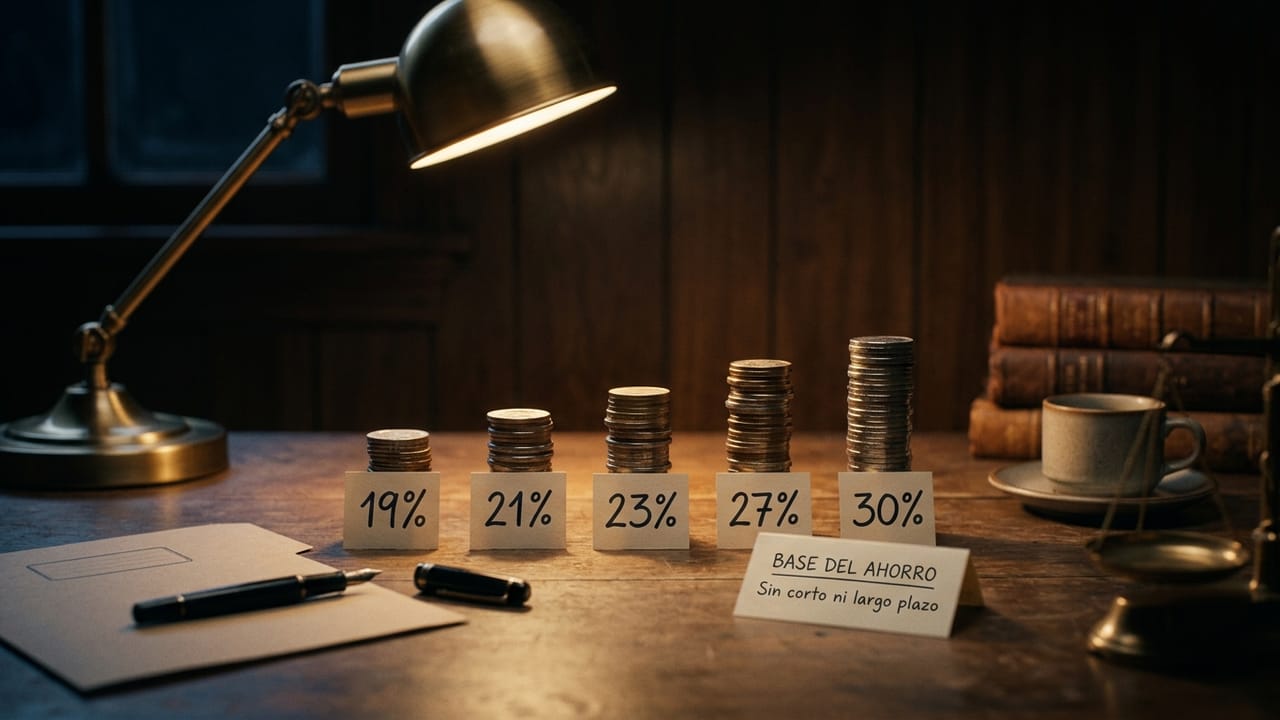
Table of contents
If you've sold stocks, fund shares, or crypto at a profit, the Spanish tax authority wants its share. The good news is that, while it has some nuances, the system isn't as complicated as it seems once you understand the basic logic.
Important note: this article is for informational purposes only and doesn't replace advice from a licensed tax professional. Taxation can vary depending on your personal situation.
It all goes into the "savings income" bucket
In Spain, your gains from selling stocks, investment funds, crypto, or any other financial asset aren't taxed the same way as your salary. They go into a separate part of the IRPF (Spain's personal income tax) called savings income (base del ahorro), along with interest from your deposits and any dividends you receive. This bucket has its own tax scale, which is the same across all of Spain (unlike general income tax, which varies by region):
| Gain (bracket) | Rate |
|---|---|
| Up to €6,000 | 19% |
| €6,000 to €50,000 | 21% |
| €50,000 to €200,000 | 23% |
| €200,000 to €300,000 | 27% |
| Over €300,000 | 30% |
It's a progressive scale: you don't pay 30% on the entire amount if your gain exceeds €300,000 — each bracket is taxed at its own rate, just like general income tax.
A nuance almost everyone misses: there's no need to hold "long term"
Unlike countries such as the United States, Spain doesn't distinguish between short-term and long-term gains. It doesn't matter whether you held the investment for one day or ten years: the same progressive savings-income rates apply.
You can offset losses against gains
If you had both gains and losses in the same year (say, you sold some stock at a profit and other stock at a loss), the tax authority lets you offset them against each other before calculating what you owe. There's an important technical detail: losses from selling assets (stocks, funds, crypto) can only offset interest and dividend income up to a limit of 25% of that income in the same year; any remaining loss that couldn't be offset can be carried forward for up to 4 years.
Crypto: the same savings-income rules, plus extra reporting obligations
Gains from selling, swapping, or exchanging crypto are taxed on exactly the same savings-income scale described above (19%-30%), and there's no tax-free minimum: technically, any gain must be declared, no matter how small. Crypto also has a couple of specifics worth knowing:
- Mandatory FIFO method. When you sell part of your crypto holdings, the tax authority requires calculating the gain using "first in, first out": it's assumed you're selling the units you bought first, not the most recent ones.
- Modelo 721. If you hold crypto assets on exchanges or wallets outside Spain worth more than €50,000, you must file this specific informational return between January and March, in addition to your regular tax return.
- Exchanges already report directly to the tax authority. Since 2024, forms 172 and 173 require exchanges (including foreign ones operating in the EU, thanks to the DAC8 directive) to report your balances and transactions. In practice, this means the tax authority already has, or can easily get, much of this information even if you don't report it yourself.
Why good record-keeping saves you headaches
The most common mistake usually isn't bad intent — it's simply losing track of when you bought each asset, at what price, and with what fees, especially if you trade across multiple platforms or have swapped between cryptocurrencies (which also triggers a taxable gain or loss, even if you never converted anything to euros). Keeping a clear, centralized record of your transactions — date, amount, purchase and sale price, fees — is, by far, what saves you the most time (and accountant fees) when filing.
The key takeaway
Investment taxation in Spain isn't as scary as it looks at first glance: a single progressive scale for all savings income, the ability to offset losses, and, in crypto's case, specific reporting obligations worth knowing before they catch you off guard. What you do want to avoid is reaching tax season with no record of your year's transactions at all.